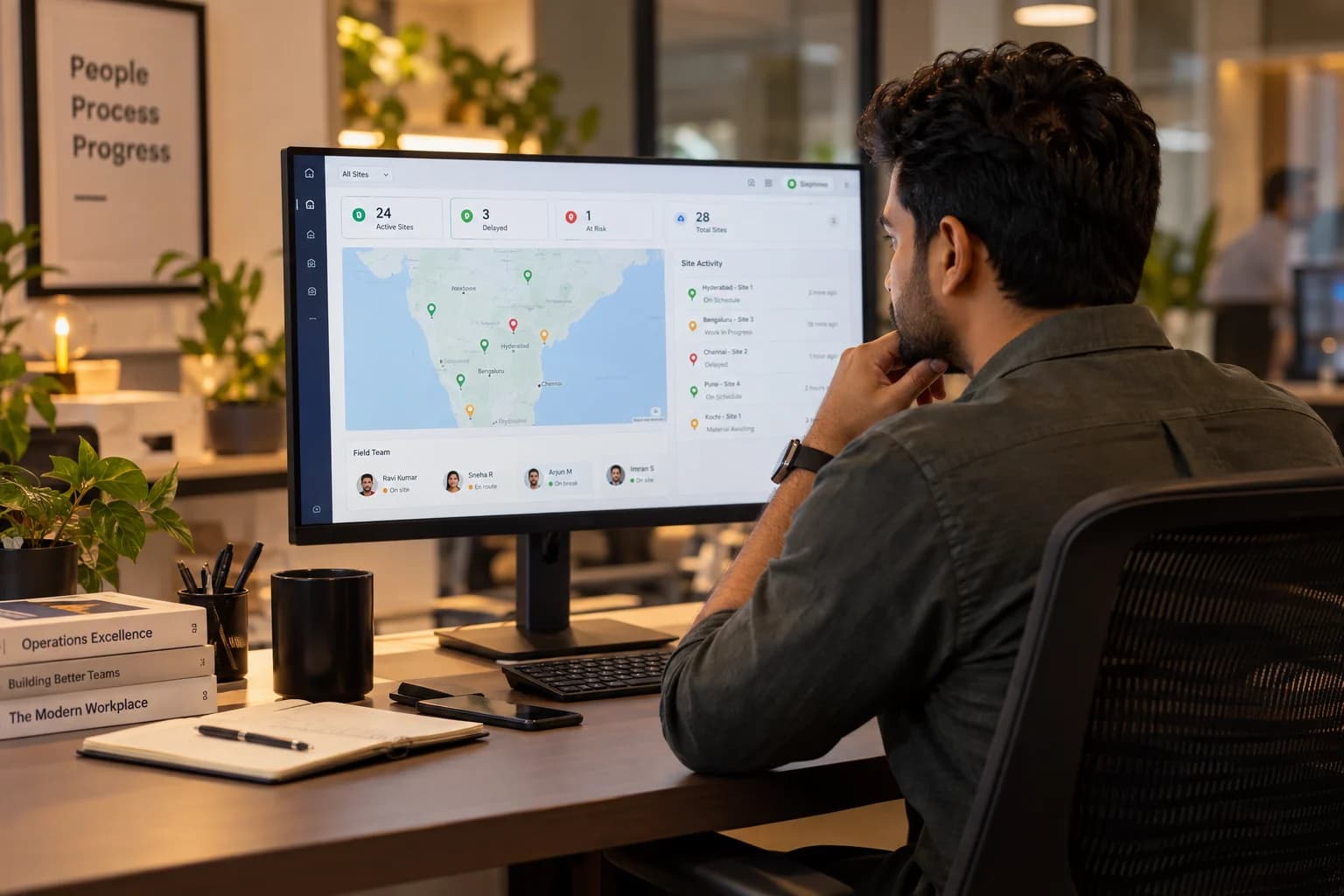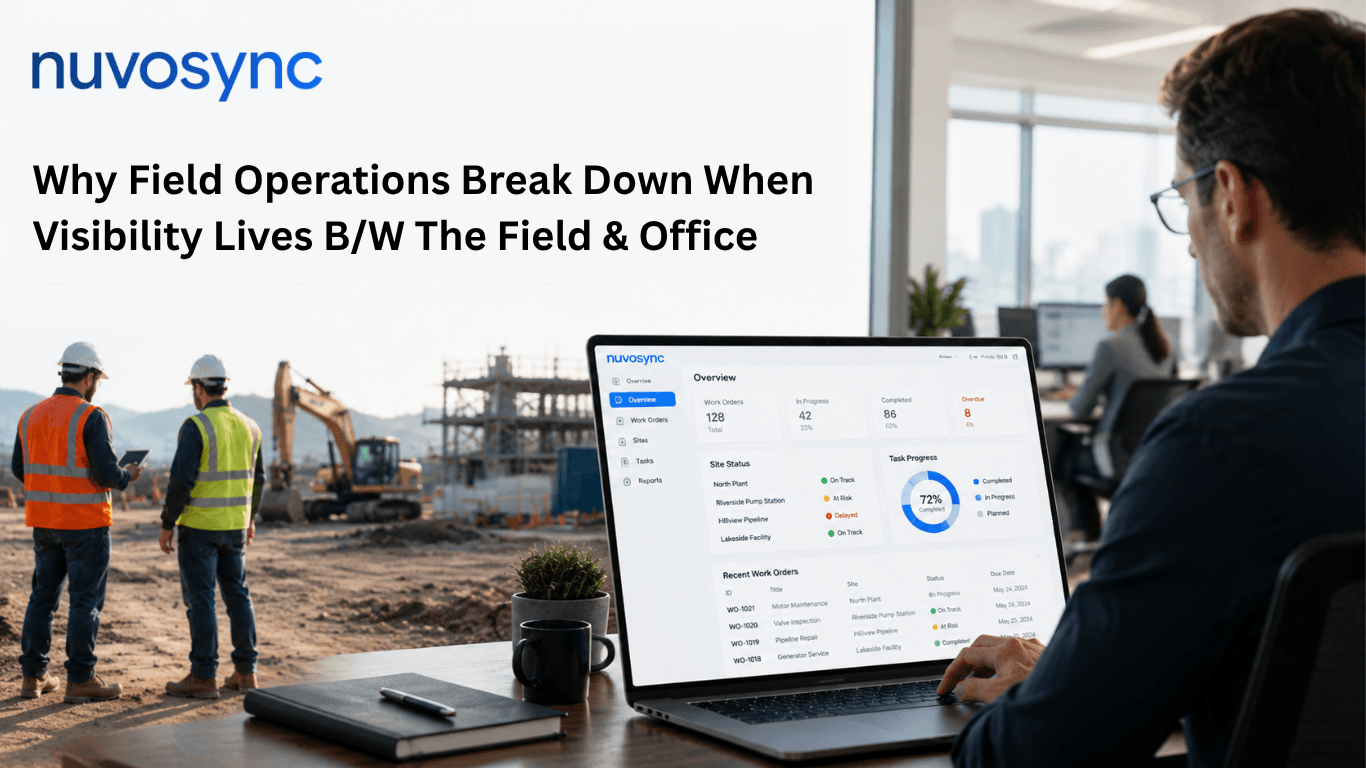

There is a pattern that shows up across industries in India wherever work happens in the field. Telecommunications networks. Facility management. Pest control. AMC and maintenance contracts. Infrastructure projects. Security deployments.
In every one of these sectors, the same gap exists between what field teams are doing and what the office actually knows is happening. The field is active. Teams are deployed. Work is getting done. And yet, the people responsible for the operation are often working with a picture that is hours or days behind reality.
This is not talked about as a crisis because it has always been this way. It has been normalized. The morning call is how you find out what happened yesterday. The end-of-week report is how you know whether targets were met. The operations manager who can reconstruct last Tuesday across 12 sites from memory is considered good at their job rather than a symptom of a broken system.
Why This Pattern Became Normal
For most of the last two decades, the alternative to calls and reports was expensive. Enterprise field service management software existed, but it was built for large organizations with dedicated IT departments, implementation budgets, and teams who could handle the training overhead. For the mid-sized operations businesses that make up the backbone of Indian industry, it was not a realistic option.
So the industry developed its own systems. WhatsApp for updates. Excel for tracking. Phone calls for everything that fell between the two. These tools were not chosen because they were the right solution. They were chosen because they were available and free and the people using them already knew how to use them.
The problem is that the industry has grown, and these tools have stayed the same. The operation running 30 field staff with one operations manager can manage on calls and spreadsheets with effort. The operation running 100 field staff across three cities cannot, but it tries anyway, and the manager pays the price in working hours.
The Industry Observation Worth Making
Here is the observation that rarely gets made directly: the field operations sector in India has systematically underinvested in operational infrastructure relative to its scale.
Companies will invest in vehicles, equipment, uniforms, training and client relationships. These are visible investments with clear justifications. The investment in the system that connects all of these moving parts, the system that turns field activity into operational intelligence, gets postponed because the cost is visible and the benefit is harder to quantify.
The result is that the operations manager is the operational infrastructure. They are the system that connects field execution to office awareness. When they leave, the organization does not just lose a person. It loses the institutional knowledge, the relationship context, and the informal systems that they spent years building in their head.
This is not a sustainable model for growth. And increasingly, it is not a competitive one either.
What Changes When Visibility Exists
The industries where field visibility has improved, through connected systems rather than more management layers, show consistent patterns.
Response time to field issues improves because problems are flagged in real time rather than reported in the next call. Client communication improves because the account manager has accurate status information to share rather than having to chase the operations team first. Billing accuracy improves because completion is documented rather than assumed.
Perhaps most significantly, the operations manager's role changes. Instead of spending the first two hours of the day reconstructing what happened yesterday, they spend those hours reviewing a picture that is already assembled and deciding what to act on. The shift from information-gathering to decision-making is the difference between a manager who is always catching up and one who is actually managing.
The Structural Shift That Is Underway
What is changing now is accessibility. The software that once required a dedicated IT team and a six-figure implementation budget is being replaced by products built for the actual scale and structure of Indian operations businesses. Products that work on the phones that field teams already carry. Products that connect to the workflows that operations teams already follow, rather than asking them to adopt entirely new ones.
This shift is happening across sectors. The question for any operations business is not whether connected field management is the right direction. The direction is clear. The question is when to make the move, and whether to do it proactively or under pressure.
Where NuvoSync Sits in This Shift
NuvoSync is built for the operations businesses that have outgrown informal systems and are not yet at the scale of enterprise software. The core premise is straightforward: field teams should be able to receive assigned work, update status as it progresses, and flag issues as they arise, all through a single interface on their phone. Office teams should be able to see all of this in real time without making a single call.
This is not a complex proposition. It does not require a transformation of how the operation works. It requires connecting the pieces that already exist: the work, the teams, and the people responsible for seeing that the work happens.
The visibility gap in Indian field operations is real, it is widespread, and it is solvable. The businesses that solve it earlier gain an operational advantage that compounds over time. The ones that wait continue to pay the cost of a system that was built for a smaller, simpler version of what they are running today.