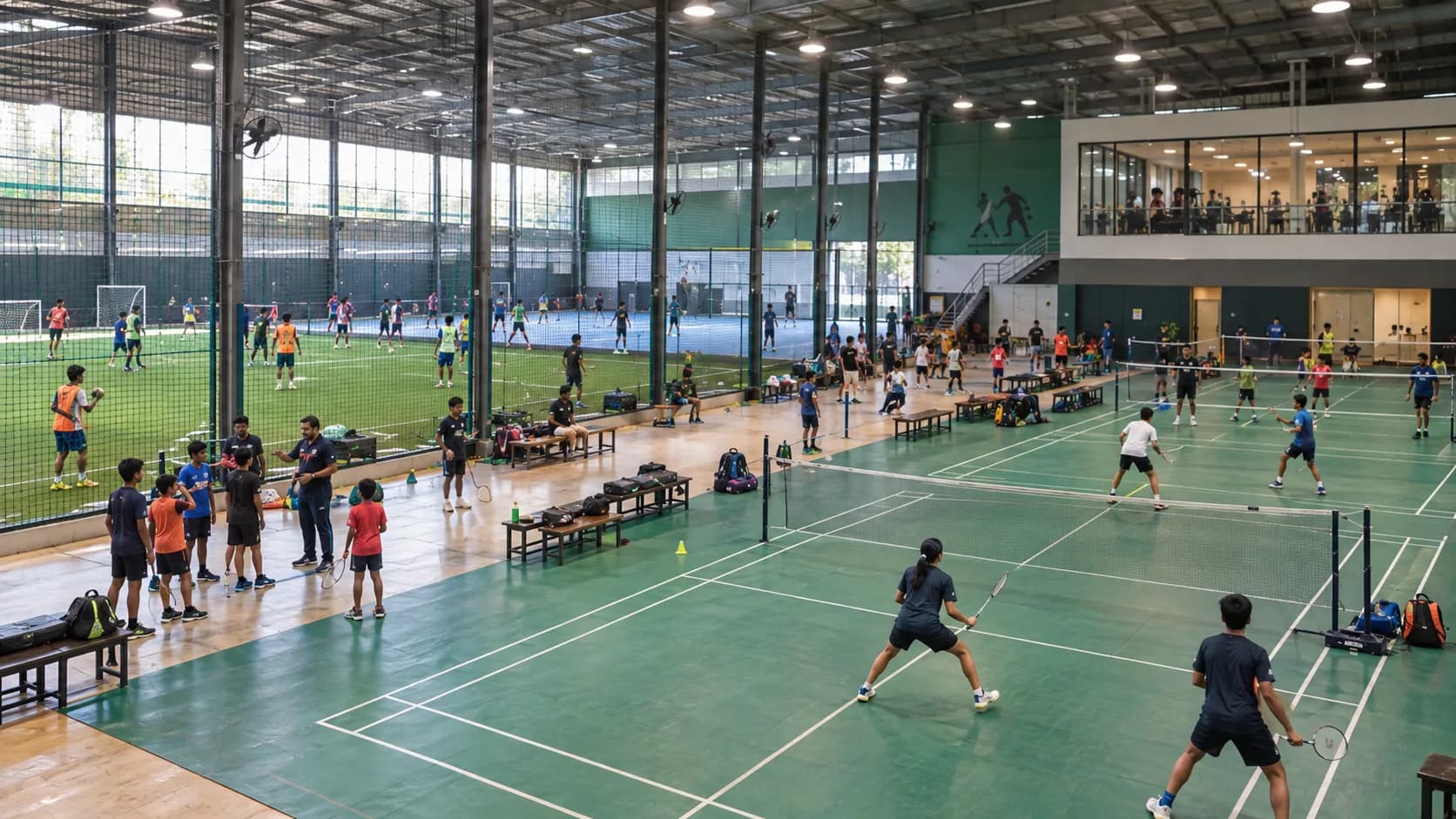

Running a sports academy starts as a straightforward operation. A few batches, a handful of coaches, a fixed schedule. You know every student by name. Fees come in mostly on time. The WhatsApp group for parents keeps everyone informed.
Then the academy grows. You add more batches. You bring in two more coaches. A second sport. A third time slot. And suddenly, the operation that used to run on memory and a few phone calls starts to strain under its own weight.
This is not a failure of management. It is what happens when the systems that work for a small operation are asked to carry a larger one. And in sports academies across India, this strain is almost universal.
What Running an Academy on WhatsApp Actually Means
WhatsApp has become the default operating system for most sports academies. Parents message to confirm attendance. Coaches send batch updates. The owner forwards schedules and follows up on fees in individual chats.
When this is working, it feels manageable. The owner is available. Messages get replied to. Most things happen because someone chased them.
The problem is that the owner is the system. Every piece of information passes through them. Every exception is handled by them. Every gap is closed by their direct involvement. As the academy grows, this becomes unsustainable, not because the owner is incapable, but because there are only so many hours in a day.
When a parent messages about a fee, someone has to check the record and reply. When a coach is absent, someone has to reschedule the batch and inform 20 families. When a batch is at capacity, someone has to remember to stop accepting new students for that slot. None of these tasks are complex individually. Together, they fill an entire working day.
The Attendance Problem
Attendance is where the operational gap becomes most visible for growing academies. A notebook is the standard tool. The coach marks attendance, the notebook lives on the desk, and at the end of the month someone counts the sessions to decide how much to charge students who pay per session.
This process works until it does not. Notebooks get misplaced. Coaches forget to mark attendance on busy days. A student disputes a charge for a session they claim they attended. The owner has no way to verify it. The relationship with the family gets awkward. Either you take the parent's word or you rely on a coach who may or may not remember.
Beyond the disputes, the notebook model makes it impossible to see patterns. Which batches have the highest dropout rate? Which students are regularly absent and might be at risk of leaving? What is the actual utilisation of each court or ground across the week? These questions are answerable only if the data exists in a form you can look at. A stack of notebooks is not that form.
The Fee Collection Reality
Fee management in most sports academies operates on trust, reminders and patience. The owner or a staff member messages families when fees are due. Some pay immediately. Others respond in a few days. Some need two or three reminders. A handful slip through to the next month and the amount compounds.
No one is deliberately avoiding payment in most cases. Life is busy. The reminder was seen but not actioned. The payment app had an issue. These are small things that accumulate into a receivables problem that no one tracks systematically.
The owner usually knows, roughly, who is behind on fees. But roughly is a problem when you have 80 families. You start to feel the gap in cash flow before you can explain precisely why it is there. The data is in messages and memory, not in a report you can act on.
What a Well-Run Academy Actually Looks Like
The academies that run smoothly at scale have separated operations from the owner's personal bandwidth. Registrations go through a defined process. Batch assignments are clear and documented. Attendance is marked digitally and visible to the owner without asking the coach. Fee dues are tracked automatically and reminders go out without anyone having to initiate them.
None of this requires a large staff or complicated software. It requires a system where the different parts of the operation talk to each other. When a student is registered, they are placed in a batch. When attendance is marked, it is linked to that student's record. When a fee cycle runs, the system knows which students are due and which have paid.
The owner's job shifts from holding all of this together manually to reviewing information and making decisions. The difference in how that feels, operationally and personally, is significant.
Where Sporte Fits in This Picture
Sporte is built as a management layer for exactly this kind of operation. It covers the core workflows that sports academies need to manage as they grow: batch management, student registration, attendance tracking, fee management, coach coordination and facility utilisation.
The goal is not to replace the human relationships that make a good academy what it is. The goal is to remove the administrative friction that eats into the time and attention of everyone running the operation.
An owner using Sporte can see which batches have open slots, which students have pending fees, and what attendance has looked like across the week, all in one place and without asking anyone. A coach can mark attendance on their phone. A parent can check their child's attendance and fee status without messaging anyone.
The operation becomes visible. And when an operation is visible, it is manageable. Problems are caught before they become expensive. Capacity decisions are based on real data rather than gut feeling. Families get a more consistent experience because they are not dependent on whoever happens to be available to answer their message.
The Right Time to Make This Change
The instinct is to wait until things are clearly broken before making a change. But the systems that work for 40 students become a liability at 150. And the cost of transition is significantly lower when you do it proactively rather than when you are already under operational pressure.
A well-run sports academy is not just one where the coaching is good. It is one where the operation supports the coaching, where families have a consistent experience, and where the owner is not the bottleneck for every decision and update.
That kind of operation does not happen by accident. It is built deliberately, with systems that match the scale of what you are running.