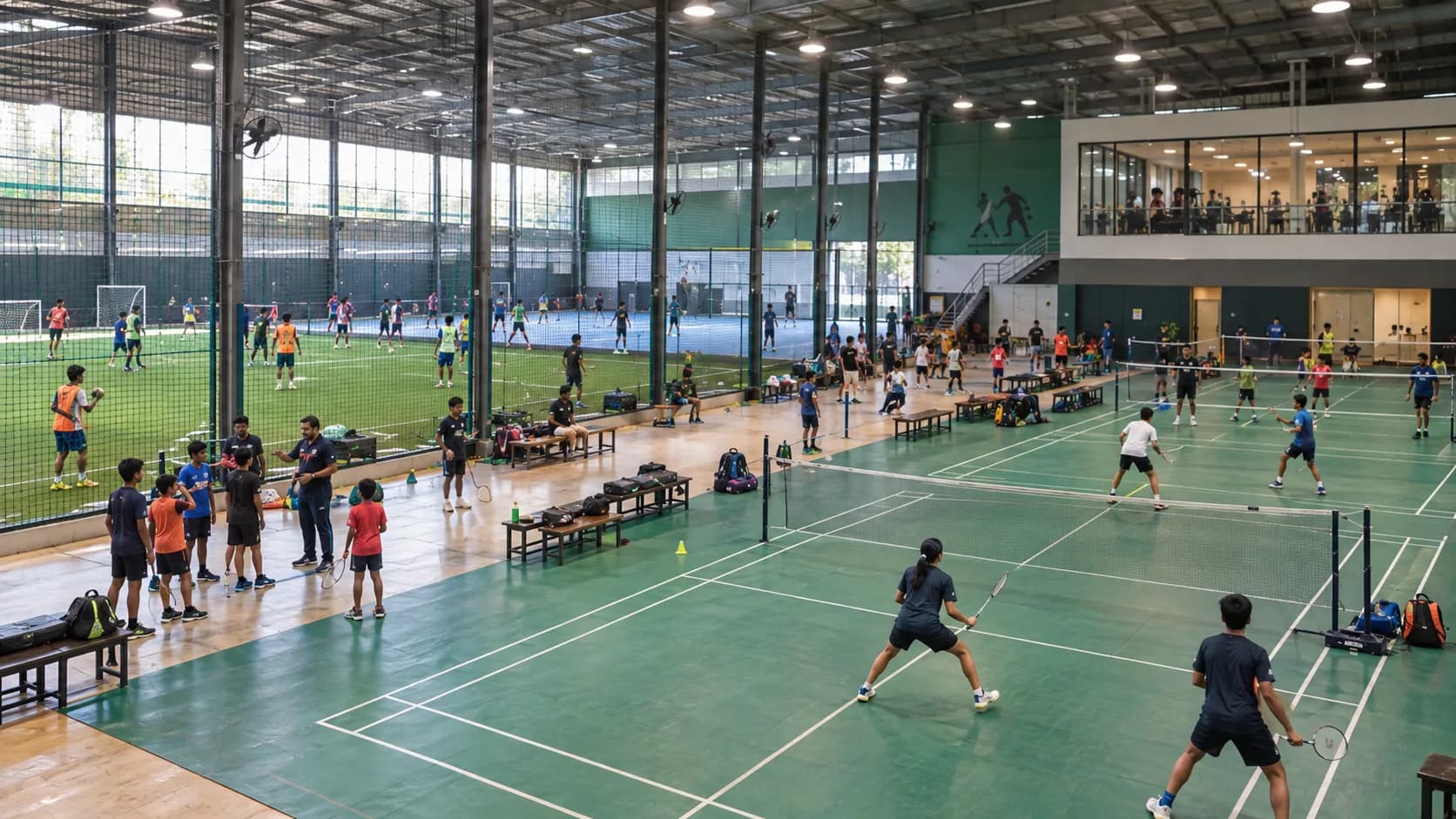
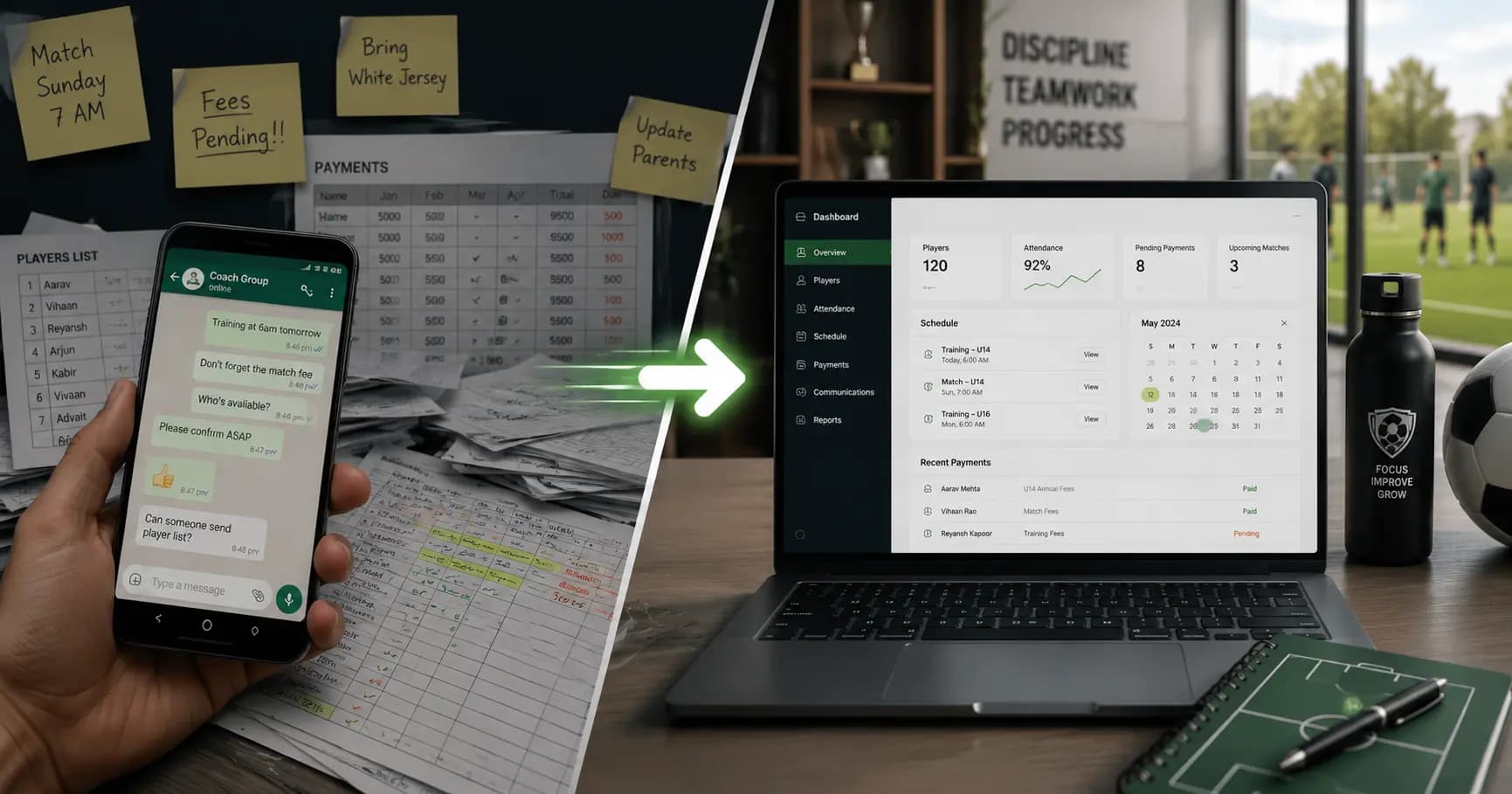
For many sports academies, WhatsApp and Excel do not begin as a problem. They begin as practical solutions. A few booking messages, a simple spreadsheet, a notebook for attendance and a coach who knows the schedule can be enough when the academy is small. The problem starts when the academy grows but the operating process does not.
When communication becomes the operating system
A member asks for a court slot on WhatsApp. The coach confirms it. Another member asks about the same time. Someone checks a spreadsheet. A cancellation arrives later. The owner has to remember that the slot is now available again.
This process can work when there are only a few bookings.
But an academy with dozens or hundreds of members creates a different level of coordination. More courts mean more availability to manage. More batches mean more schedules. More coaches mean more assignments. More recurring members mean more attendance and fee records.
WhatsApp remains useful for communication, but it becomes difficult when it is also expected to be the booking system, attendance record and operational history.
That is where the need for a dedicated academy-management system begins.
Bookings are only one part of the problem
It is easy to think that sports-facility software is primarily about court booking.
Booking is important, but the academy has several connected workflows around it.
A batch has a schedule and a coach. Members attend sessions. Fees recur. Courts and grounds have limited capacity. Owners want to understand revenue, attendance and utilisation.
If every one of these activities lives in a different place, the owner remains responsible for connecting the information.
Sporte brings these core activities into one mobile-first system: online booking, batch scheduling, attendance, fee collection and reporting.
The objective is not simply to replace a spreadsheet. It is to give the academy one operational place for the information it already creates every day.
Why attendance should become useful information
Attendance is often recorded because it has to be recorded.
A coach marks names in a notebook and moves on to the next session. Later, the owner may want to know who is regularly attending, how a batch is performing or whether participation is changing.
Without a digital record, those questions can require manual work.
Sporte allows coaches to mark attendance through the app while the owner gets visibility across batches from the dashboard. The activity that was already happening becomes a usable operational record.
That matters because attendance is not only an administrative task. It can help an owner understand the rhythm of the academy.
Fees should not depend on memory
Recurring fee collection creates another predictable burden.
The owner needs to know who has paid, who has not, when payment was due and whether a reminder has already been sent. When payment information is spread across cash records, messages and spreadsheets, the process depends heavily on memory and follow-up.
Sporte provides payment tracking, digital receipts and automated overdue reminders within the academy workflow.
This does not make fee collection a separate finance operation. It keeps it connected to the members and academy activity the owner is already managing.
The result is a clearer process and less dependence on manual follow-up.
From managing bookings to understanding the facility
A sports facility has finite capacity.
A court can be booked at one time and empty at another. A batch can fill a recurring slot while another remains underused. A multi-sport complex can have several facilities operating simultaneously.
Without structured data, an owner may know that the academy is busy without knowing exactly how the capacity is being used.
Sporte brings revenue, attendance and utilisation into its reporting and dashboard experience. This gives owners a broader view of the academy rather than forcing them to assemble information from separate sources.
The goal is not to create more reports. It is to help the owner see the operation more clearly.
The owner should run the academy, not its memory
There is a stage in an academy's growth where the owner becomes the connector between every process.
They know which coach handles which batch, which court is available, who has paid, who attended and what changed in the schedule. That may work for a small operation, but it becomes fragile as the academy grows.
Sporte is designed to move that operational knowledge into a structured system.
Members can book available slots. Coaches can manage batches and attendance. Owners can manage the operation and review reports.
The goal is not to remove the owner's involvement. It is to remove the need for the owner to remember everything.
That is the practical shift from running an academy through WhatsApp and Excel to running it through a dedicated sports-facility management platform.
What this means for the organisation
The larger lesson is that an academy does not become easier to run simply because it has more members. Growth increases the number of bookings, batches, attendance records and fee cycles that have to stay coordinated. Sporte is designed to give the owner and coaches a structured operating layer without turning the academy into a generic enterprise system.
Why the operating model matters as the academy grows
An academy with 30 members can often compensate for an informal process because the owner knows most of what is happening. The handbook identifies a broader operating range of roughly 50 to 500 members where these manual processes become a real daily pain.
Growth adds coordination in several directions at once. A new batch creates another schedule. A new coach creates another assignment. More members create more attendance and fee records. More courts create more availability to manage.
The problem is not growth itself. It is trying to manage a larger operation with the same informal process that worked when the academy was smaller.
Sporte is designed around that transition. It gives the academy a structured place for bookings, batches, attendance, fees and reporting while keeping the language and workflow specific to sports facilities.
Different people need different views of the same academy
The owner, coach and member are not trying to accomplish the same thing.
A member wants to find and book an available slot. A coach needs to manage a batch and mark attendance. An owner needs to understand bookings, fees, attendance and utilisation across the facility.
A useful system connects those activities without asking each person to manage the entire operation.
That is why Sporte's value is broader than online booking alone. Booking is one part of the member experience, while batch management, attendance, payment tracking and reporting support the operational side.
The academy gets one connected workflow while each person can focus on the part of the operation relevant to them.
A sports facility is a business with limited capacity
Courts, grounds and pools are physical assets with defined operating time. That makes utilisation an important part of the owner's view.
The academy may be busy overall while particular slots remain underused. A batch may occupy a recurring period while another part of the schedule has room. Without structured records, those patterns are difficult to see consistently.
Sporte's reporting brings revenue, attendance and utilisation into the dashboard so the owner can look beyond individual bookings.
The point is not to promise that software automatically increases revenue. The point is to give the owner a clearer operational picture from which better scheduling and facility decisions can be made.
Where the product fits
Sporte is a sports facility management and booking platform for sports academies and clubs in India. Its documented workflows cover online bookings, batch schedules, attendance, fee collection and reporting. It is specifically for sports facilities and is not positioned as a gym or general business-management product.
The practical starting point
The shift does not have to happen all at once.
For an academy owner, the practical starting point is recognising where the most repetitive coordination currently lives. It may be booking requests on WhatsApp, attendance notebooks, fee follow-ups or a spreadsheet used to understand court availability.
Sporte brings those core workflows into one place. The goal is to replace the fragmented operational layer rather than force the academy to replace every tool it uses for communication or every part of its wider business.
Why purpose-built language matters
Software adoption is easier when the system reflects the way people already talk about their work.
An academy owner thinks in courts, grounds, pools, batches, slots, coaches, members and fees. Calling those things generic “resources,” “users” and “appointments” can make software feel like it was built for someone else.
Sporte uses sports-facility language because the product is designed for sports academies and clubs. That specificity is not cosmetic. It helps the product fit the operating model the academy already understands.