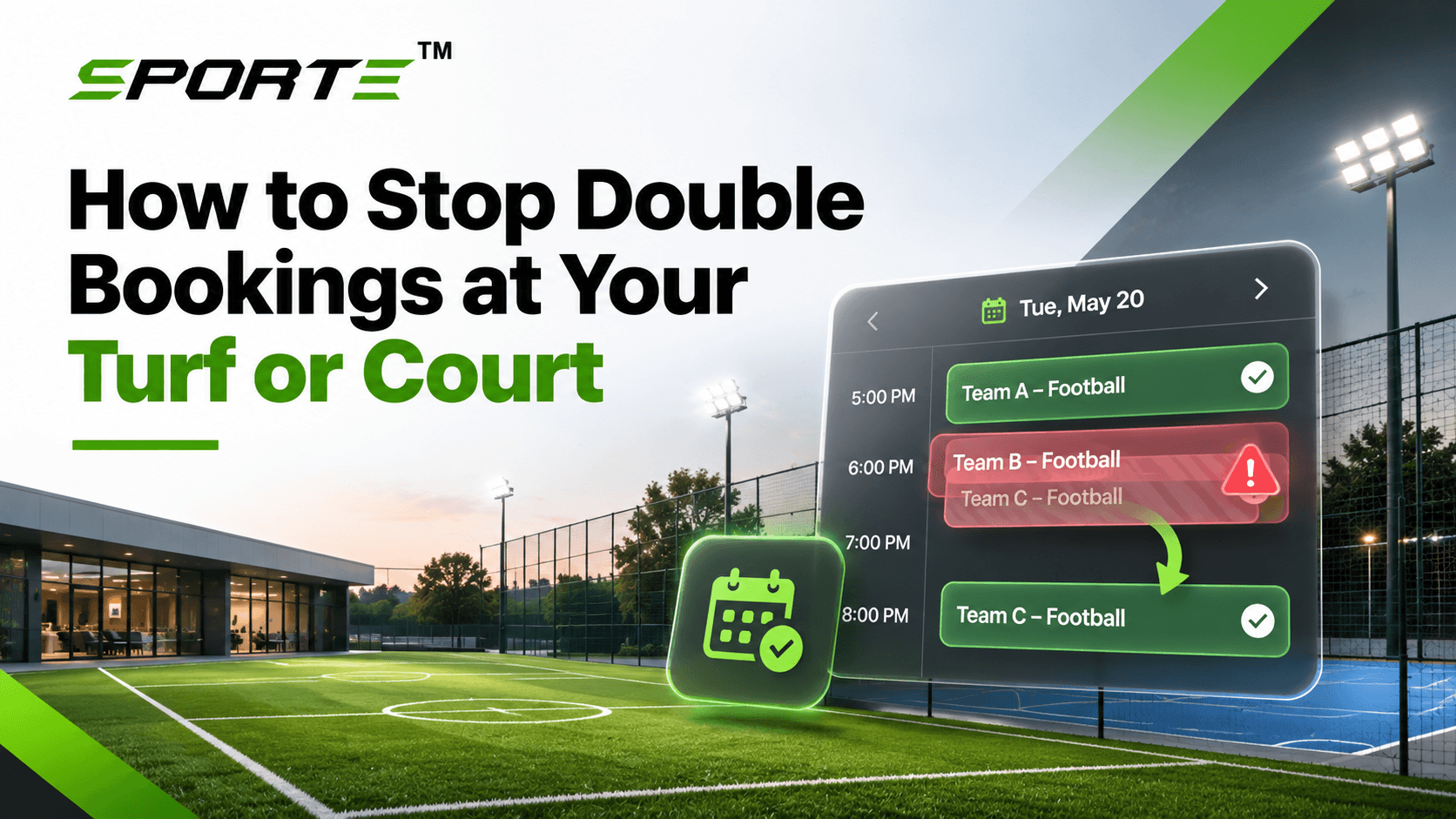
It's 6:45 on a Saturday evening. Ten football players have walked into your turf, paid their share and are lacing up. Then another group arrives with the same slot, and a message on someone's phone to prove it. Two confirmations, one pitch. Whatever you do next, somebody leaves unhappy.
Double bookings are one of the most common problems in sports venue management, and one of the most avoidable. Once you understand why they happen, the fix is usually less about working harder and more about changing where bookings are recorded.
Why double bookings happen
They almost never come from carelessness. They come from the way bookings are taken.
More than one place to book. A slot gets confirmed over a phone call, another over WhatsApp, a third by a staff member at the counter. Each one is recorded somewhere different, or only in someone's memory.
More than one person confirming. When the owner, a manager and a coach can all say yes, nobody has the full picture at the moment they say it.
Slow updates. The sheet is updated at the end of the shift, not at the moment of booking. In between, the "free" slot is no longer free.
Cancellations and reschedules. A booking moved from Thursday to Friday frees one slot and takes another. If either change is missed, the calendar is wrong from then on.
Recurring bookings. Weekly slots for a regular group or a coaching batch are easy to forget when a one-off request comes in for the same hour.
What a double booking really costs
The visible cost is an awkward conversation and perhaps a refund. The bigger cost is trust. A customer who was turned away at the door doesn't think "mistakes happen." They think "I can't rely on this place." For a turf that depends on repeat bookings from the same groups every week, that's an expensive impression.
There's also the internal cost. Staff spend time apologising, finding alternatives and re-checking the calendar, instead of running the venue.
Seven steps that actually stop them
Keep one master calendar. Every booking, from every channel, goes into the same place. If a booking isn't in the calendar, it doesn't exist.
Let the calendar be the source of truth for customers too. Instead of asking "is 7 pm free?", customers should be able to see availability themselves.
Block the slot at the moment of booking. Not at the end of the day, not once payment arrives. The instant a booking is confirmed, nobody else should be able to take it.
Tie confirmation to payment or an advance. A slot held with no commitment tends to be abandoned, and the empty hour is lost. Confirming against an advance keeps the calendar honest.
Handle cancellations and changes in the same system. A cancelled slot should reopen automatically, and a rescheduled one should move cleanly rather than leave a ghost booking behind.
Set up recurring slots properly. Regular groups and coaching batches should be entered once as recurring bookings so one-off requests can't land on top of them.
Limit who can override. If staff can edit anything, mistakes slip in quietly. Keep a record of who changed what.
Why a spreadsheet only gets you partway
A shared spreadsheet fixes the "one place" problem, but it can't stop two people typing into the same cell, it doesn't know a slot is taken until someone looks, and it can't let customers check availability on their own. It also can't take payment. So the owner is still the middleman for every booking, which is exactly where mistakes creep in.
What to look for in a booking system
If you decide to move to software, the features that matter most for double bookings are fairly specific:
Live availability by sport, court or turf, with slot timings and pricing you set yourself.
Online booking that blocks the slot instantly.
Payment links or online payment tied to the booking.
A way to add walk-in bookings from the counter into the same calendar.
Booking history for every customer, so repeat groups are easy to manage.
How SportE handles it
SportE, the sports venue and academy management platform we build at Weblabs, keeps bookings in one calendar with venue, sport, court and slot setup, online booking with payment links, and walk-in management for the front desk. Each venue also gets its own branded booking website, so customers book from the venue's own page instead of by chat. You can read more at sporte.in.
Frequently asked questions
Can I avoid double bookings without software? You can reduce them with a single shared calendar and a strict rule about who confirms slots. Once you have several courts, several staff or online enquiries, it becomes hard to keep it reliable by hand.
What should I do when a double booking has already happened? Offer the next available slot first, apologise plainly and refund or credit if they can't make it. Then trace where the second booking came from, because that tells you which channel needs fixing.